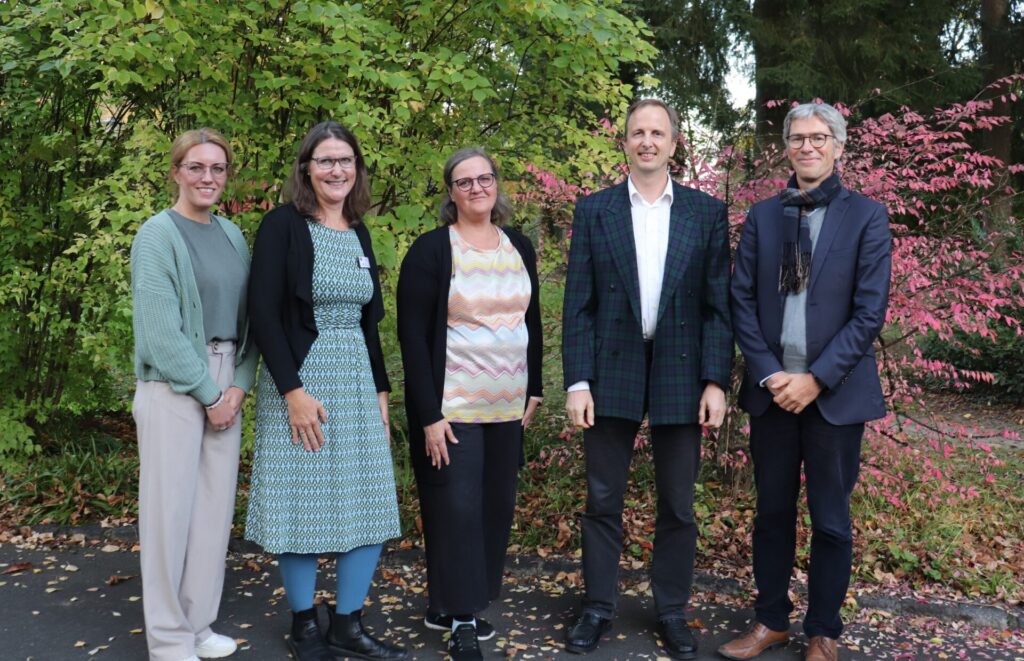

For the 15th time, experts from various professional groups provided information on the latest developments in the diagnosis and treatment of difficult-to-treat forms of epilepsy. For the first time, the traditional event was not held in Ravensburg's Schwörsaal as before, but on the clinic grounds of the NDT in Weissenau. „With the event here on site, we want to raise awareness of the treatment options available at our clinic,“ explained PD Dr Christian Tilz, Head of the Department of Neurology and Epileptology. Dr Andreas Honikel-Günther, First Mayor of Ravensburg, expressed his thanks to him and his team. The NDT with its expertise is an indispensable part of the city, he said. „Events like this help to make the complex disease of epilepsy more tangible and take the fear out of it.“
Tilz emphasised that there is hope and progress in research for people with difficult-to-treat forms of epilepsy with reference to new seizure-suppressing drugs. He described the drug fenfluramine, which is used for rare forms of epilepsy such as Dravet syndrome, as a prototype of a new type of medication for individual epilepsy syndromes. However, a third of all epilepsy sufferers do not receive sufficient help from drug therapy. „Surgical procedures offer the chance to eliminate the cause of the disease.“ As a third option for treating severe epilepsy, the head physician presented three neurostimulation procedures: From the tried-and-tested vagus nerve stimulation (VNS) to deep brain stimulation and the new epicranial stimulation (EASEE). „Targeted therapy options with good tolerability and efficacy are being developed,“ said Tilz, encouraging those affected. He then explained why a first epileptic seizure does not necessarily mean that you have epilepsy. Five per cent of people suffer a seizure in their lifetime. „It is then important to diagnose the seizure and the circumstances that led to it.“ The misdiagnosis of epilepsy increases in older people in particular, as symptoms such as impaired consciousness or speech disorders are misjudged or misinterpreted. „A comprehensive differential diagnosis is absolutely essential. Because the right diagnosis determines the success of treatment.“
Electroencephalography (EEG) plays a decisive role in diagnostics, as Anja Lau, an employee of the EEG laboratory, explained. The medical-technical assistant pointed out the advantages and disadvantages of various EEGs. While a routine EEG lasting only twenty minutes is usually used for basic diagnostics and therapy monitoring, a mobile long-term EEG is also used for differential diagnostics. This involves electrically recording the patient's brain waves for several days. „With video EEG monitoring, seizure situations are also recorded on video, which allows us to draw valuable conclusions about the type of seizure.“ Video and EEG are transmitted one-to-one. As certain seizures can only be classified using video analysis, Lau emphasised in conclusion, this procedure is so important.
New perspectives for those affected
A diagnosis of epilepsy presents many affected people with new challenges: „How do I deal with my fears? How do I cope with my new everyday life, job and leisure activities? Can I still drive?“ In her presentation, social worker Heike Bierenstiel explained that the disease is not just about medical issues, but that socio-educational counselling also plays a key role. „In a protected environment, we work with those affected to find solutions and new perspectives.“
Mirijam Geiger-Riess, who works as a psychological psychotherapist at the ZfP, focussed on the topic of diagnosing dementia in people with intellectual disability and epilepsy and the associated challenges. Those affected, especially those with trisomy 21, have a five-fold higher risk of developing dementia. „Symptoms such as lethargy and social withdrawal occur before disorientation and memory disorders,“ says the neuropsychologist about the different course of the disease. As various factors make early diagnosis difficult, she advises close observation of the developmental process and annual screening with a questionnaire. „A follow-up examination is required for intra-individual comparison.“ According to the speaker, the aim is to maintain quality of life and participation for as long as possible and to enable early treatment for those affected.
The lively questions from those present in the packed hall of the Alte Schwimmhalle showed that there is great interest in the latest research findings, treatment methods and tips on the clinical picture. A lecture evening for experts, relatives and sufferers is also planned for next year.